
Skip to content

This site is intended for Irish healthcare professionals only. If you are not an Irish healthcare professional, please visit our dedicated site for more information at beonemedicines.co.uk

DESIGNED TO BE DIFFERENT

by minimising off-target effects in the treatment of B-cell malignancies3–6

The development of BRUKINSA began in 2012 as a collaboration between the medical, biochemistry, discovery biology, and in vivo pharmacology departments at BeOne. The team screened more than 3,000 compounds to find the molecule with the highest therapeutic potential: BGB-3111 (the 3,111th compound screened), later named zanubrutinib.2

Like other covalent BTK inhibitors, BRUKINSA is a small molecule that binds irreversibly to cysteine 481 in the ATP binding pocket of BTK. However, its molecular structure offers a distinct pharmacokinetic profile.2,3,5,7

The only BTK inhibitor that provides up to 100% occupancy (median steady-state)3

  • Occupancy in PBMCs was 100% with both BID and QD dosing
  • Occupancy in lymph nodes was 100% with BID and 94% with QD dosing

The clinical significance of in vivo and in vitro studies has not been established. Mechanism of action statements are not meant to imply efficacy or safety.

What is Brukinsa

Adapted from Tam, et al. 2021.3

Scroll left and right to see more

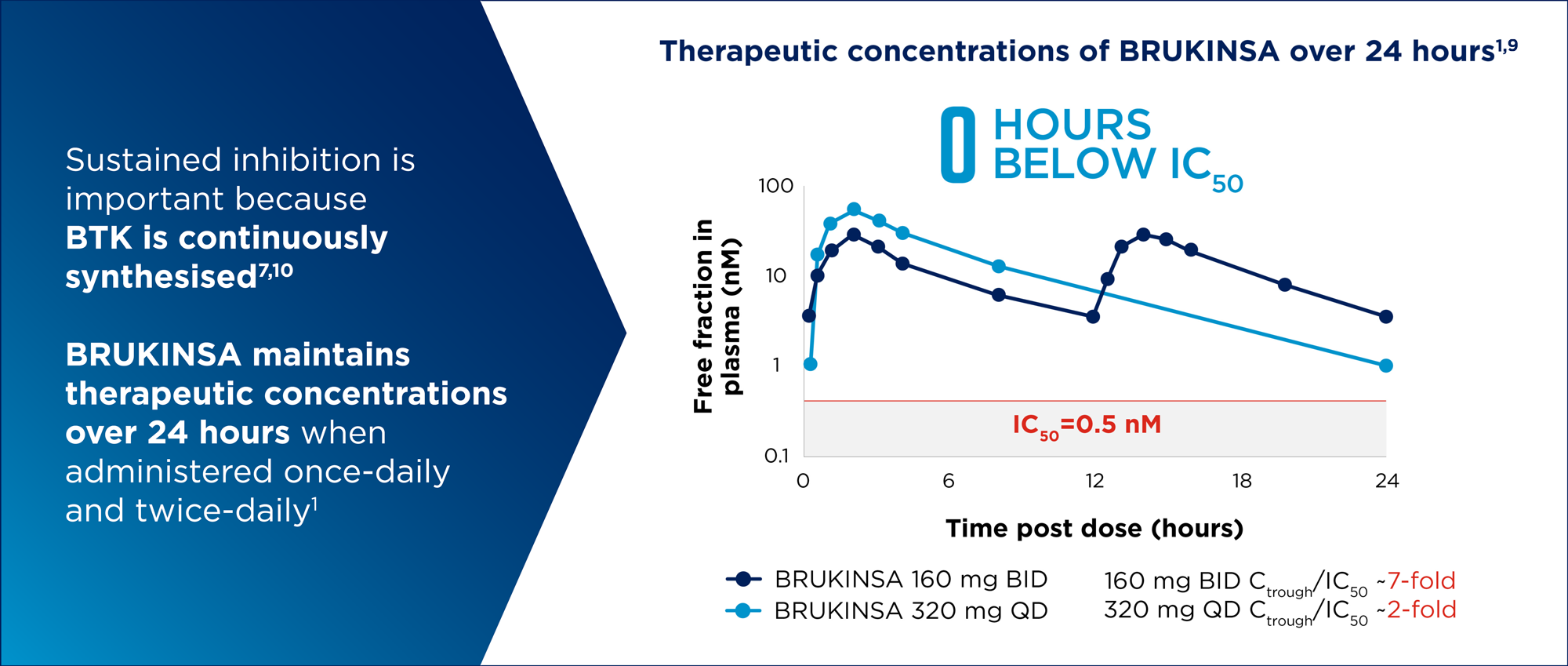
The IC50 is the drug concentration that achieves 50% inhibition.9

BRUKINSA kinase selectivity2

A KinMap dendrogram showing the selectivity profile of BRUKINSA. Larger circles indicate greater inhibition.

Scroll left and right to see more

CLL in adults who:

  • Are TN and have del(17p) and/or TP53-mutated positive disease
  • Have R/R disease following at least one line of prior therapy

Published: September 2023

WM in adults who:

have received at least one prior therapy, or as first-line treatment for patients unsuitable for chemo-immunotherapy

Published: May 2022

Select an indication to learn more about BRUKINSA: